Wednesday, December 3, 2014


The Father Of Academic Obstetrics:
Dr John W. Williams


   John Whitridge Williams was born in Baltimore on January 1866 into a well-respected medical family. His driven nature and personality was evident from early adulthood. He entered Johns Hopkins University in 1884 at the age of 18 and graduated BA in 1886. He completed his medical course at the University of Maryland also in the brief period of two years, becoming qualified as a doctor in 1888 at the age of just 22. Immediately he set out for Europe, studying bacteriology and pathology in Vienna and Berlin. Returning to Baltimore in 1889, he joined the newly opened gynecologicalobstetric department at Johns Hopkins Hospital under the leadership of famed surgeon, William Halstead. His academic research in women’s health gained him much popularity and well deserved respect. In 1892, at a mere 26 years of age, he was admitted to the American Gynecological Society with a thesis on tuberculosis of the female generative organs. In 1899, 10 years after joining the new faculty, he was promoted to professor in obstetrics to the university and obstetricianinchief to the hospital, while Dr Howard Kelly remained chief over Gynecology.


     Just four years after his appointment as obstetricianinchief, Williams published in 1903 his textbook Obstetricscataloging and describing current and practical management strategies for the field. The textbook came out of Williams' desire to render everything about pregnancy and birth in scientific terms. The first edition contained more than 1,000 references to other medical publications. The obstetrics text bearing his name is still in print today and still considered one of the premier authorities on the subject. Recent editions have been published by Dr. F. Gary Cunningham and associate faculty at the University of Texas Southwestern Medical Center/ Parkland Hospital in Dallas, Texas.


In 1911, Williams became dean of the Hopkins Medical School, a post he held for 13 years. In 1919 he became a full time professor of obstetrics. He is recognized as the founder and leader of academic obstetrics in the United States.


Sunday, November 16, 2014

The "Science" and History of Female Hysteria: A Wild Diagnosis, But Even WILDER Treatment

She's So Hysterical!

The "Science" and History of Female Hysteria: A Wild Diagnosis, But Even WILDER Treatment


In terms of strange or bizarre historical diagnoses in women's health, that of "Hysteria" may top the list. No longer recognized as a true medical disorder today, female hysteria was a once common medical diagnosis for a variety of female ailments – both physical as well as psychological. Oddly enough, we still use the term "hysterical" in our modern day vocabulary:
"Did you see such and such movie? It was hysterical!"
 Or
"She was so hysterical after she failed the test we could not even reason with her."

However, if we trace back both the meaning and the treatment of this common day verbiage, we may be more hesitant to use it in our daily dictum.


Historical Perspective


Egyptian


You may be surprised to know that the first description of the condition of hysteria dates back to ancient Egypt circa 1900 BC. This disorder of emotional state was thought to originate from spontaneous movement of the uterus within the female body. References to this condition can be found in the ancient medical treaties, the Kahun Papyri. These ancient Egyptian text describe the variety of mathematical and scientific topics. Most of these texts can be dated to circa 1820 BC.
Among the oldest of these documents (1600 BC) a remedy for symptoms of depression related to hysteria can be found. Due to the "wandering uterus theory", therapies varied based on where the uterus was thought to reside. For example, if the uterus had "floated" towards the head, the patient may be treated by placing malodorous herbs by the nostrils thereby forcing the uterus back down towards the pelvis. Alternatively, if uterus had fallen to low in the pelvis, acrid herbs to be placed near the vaginal entrance in order to drive the misplaced uterus cephalad.


Greeks


The term hysteria can be traced back to the great physician Hippocrates (5th century BC). Based upon historical writings, is evident that he also believed in the "wandering nature" of the uterus. In fact, the term is taken from the Greek word for  uterus, hyst. in his collection of medical writings, the Hippocratic corpus, a variety of systematic irregularities are described supposedly caused by the movement of the woman's uterus. One exert recommends pregnancy to cure such symptoms. As described therein, intercourse would "moisten" the womb and facilitate blood circulation within the female body.


Rome

Claudius Galenus (2nd Century AD) also sought to elucidate this mysterious female ailment. Galenus was a prominant Greek physician, surgeon and philosopher in the Roman Empire. In one of his written treatises, Galen describes his findings:
"I have examined many hysterical women, some stuporous, others with anxiety...the disease manifests itself with different symptoms, but always refers to the uters". Galenus' proposed treatments for hysteria included purgers, administration of herbs, and sexual release following marital arrangements. 

Middle Ages

  
During the middle ages, doctrinal teachings of Hippocrates and Galen continued to be propagated. A chief advocate for women's health in the Middle Ages was surprisingly, a female physician.  Trota de Ruggiero (11th Centry AD). Trota is considered the first female doctor in Christian Europe. 


Trota (as known as Trota of Salerno) was born around 1090 AD, and was a student at The Scoula Medica Salernitana- which many scholars believe was the first medical school in the Western World. It was among the first to allow female students into the study of the healing arts.  In devoting herself to women and their particular medical needs, she was arguably the first gynecologist, and advocate for women's healthcare. She is known for having written two important works on women’s' health and even commented on the nature of hysteria. The medieval medical writings of Trotula blamed the disease on "the retaining of blood or of corrupt and venomous uterine humors that should be purged in the same way that men are purged of seed."


During the late Middle ages (1500-1700s), the supernatural provided theories of its own. The "Malleus Maleficarum" (Latin for "The Hammer of Witches") was a popular and famous book on witches and evil in the time period. This book called the uterus the source of evil, and hysteria ceased to be a physical disease to become a supernatural one. Prayers, incantations and exorcism were suggested, as well as protective amulets, to cure the possessed and protect the pure. Torture and executions were often carried out as well. 


However, the Greeks and Romans had already claimed that hysteria was linked to the uterus and sex, and these beliefs were reintroduced during the Middle Ages as more Ancient texts became available, thus changing the perception of hysteria from a supernatural (demonic) disease to a physical one. Based on the translations of Hippocrates's and Galen's texts from Ancient Greek and Latin into Arabic, which were in turn translated back into Ecclesiastic Latin, it was determined that the womb, an not demons, was the source of the ailment.


Victorian Era


According to the published work by Rachel Maines (The Technology of Orgasm: "Hysteria", the Vibrator, and Women's Sexual Satisfaction), hysteria was the second most common diagnosis in women after fevers. Its presence was defined by a constellation of symptoms-anxiety, nervousness, pelvic pain, erotic fantasies, and even fainting. Another theory was proposed in addition to that of the wondering uterus in the 17th century. The condition was believed to result from uterus "choking" the patient because of unexpended seed caused by sexual deprivation. Women with hysteria were encouraged to marry quickly or were not possible, engage in activities such as horseback riding or the use of "female swings" to aid in relieving the deprivation.


Homas Sydenham, an influential British physician (mid- to late-1600s)  wrote that these afflicted ladies were wandering around ubiquitously. Sydenham once declared that female hysteria -- which he attributed to "irregular motions of the animal spirits"- was the most common cause for female dysfunction. 

Treatments

One of the earliest records of treatment originates by Galen (2nd Century). As Galen believed the root cause to be female sexual frustration, most of his proposed therapies had to do with marriage and sexual intercourse.  For the virgins or widows, he prescribed “pelvic (genital) massages” until “release” occurred. His techniques would be cited by physicians for centuries to come. During the 1100s, in addition to marriage and pelvic massage, irritating suppositories and fragrant salves were suggested as treatment. The twin treatments of marriage or pelvic massage continued into the Renaissance era. In the mid 16th Century, French surgeon Ambroise ParĂ© continued to encourage pelvic massage as the panacea for hysteria, and as expressed in his sixteenth century text, married women should "bee strongly encountered by their husbands” to have release. As an adjuvant therapy, some began to advocate “water massage” of the pelvis for those not responsive to traditional techniques.  By the mid-1800s, spas throughout Europe and the United States offered the "douche"—a spray of water directed at the pelvic area—as a treatment that, according to one writer in 1851, seemed to especially "commend itself to the ladies." British observer Therme Malvern in 1851 wrote that after "hydrotherapy" women were happy as if "they drank champagne."
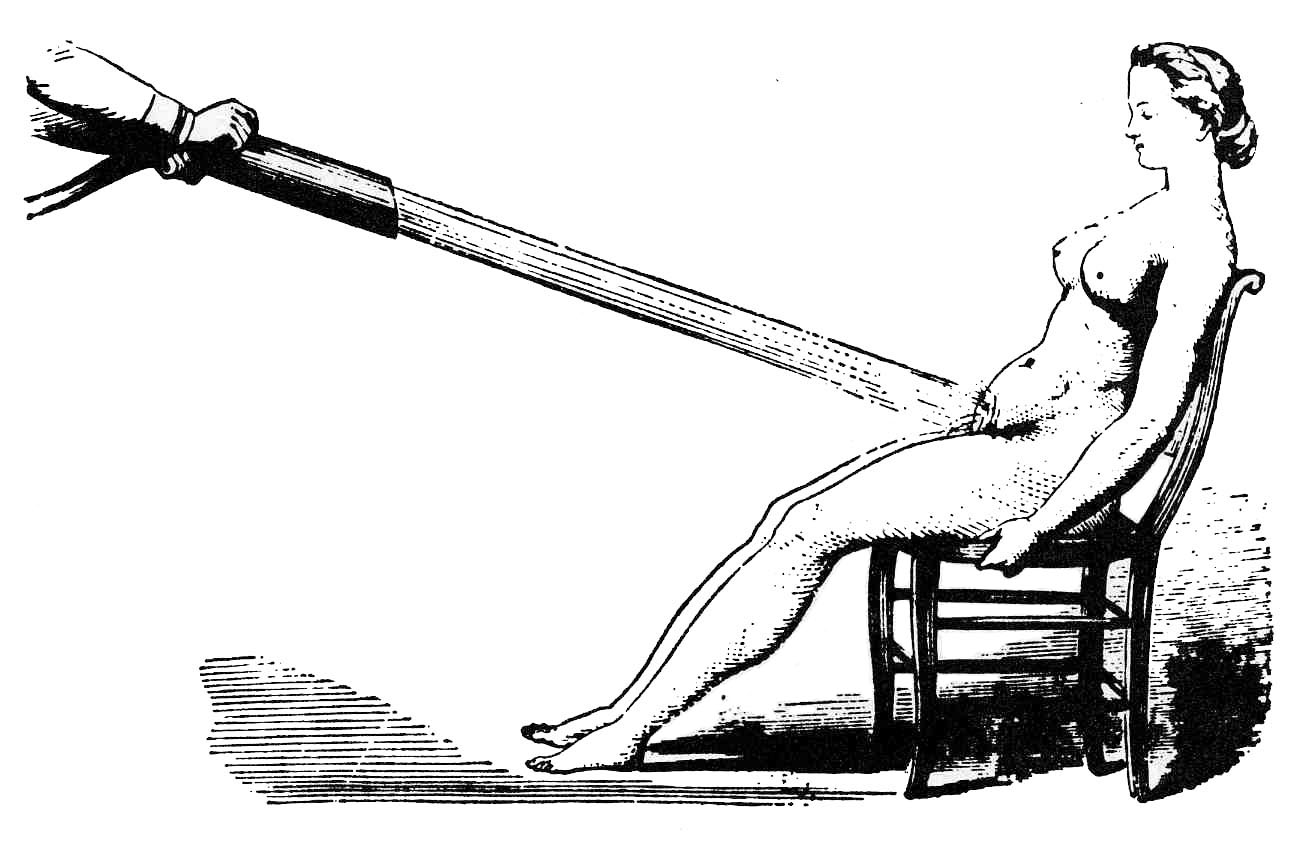
Water massages as a treatment for hysteria (c. 1860)

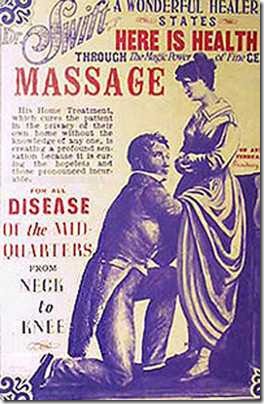
These "pelvic massages" were to be performed manually, until the patient reached a "hysterical paroxysm", after which she appeared miraculously restored. The pelvic massage was a highly lucrative staple of many medical practices in 19th-century London, with repeat business all but guaranteed. There is no evidence of any doctor taking pleasure from its provision; on the contrary, according to medical journals, most complained that it was tedious, time-consuming and physically tiring. However, historical reports do describe ladies enjoying the therapy. Wealthy women from the higher strata of society regularly visited their personal physicians. The massage was administered once a week, sometimes doctors have resorted to alternative procedures for stimulation. This being the Victorian age of invention, the solution was obvious: devise a labour-saving device that would get the job done quicker, and perhaps, more discretely. What ensued next…yes, you guessed it.
The first electric vibrator hit the scene in the late 1800s, which decreased treatment times from as much as an hour to as little as 10 minutes. George Taylor, an American doctor, patented the first steam-powered vibrator in 1869. A far cry from its sleek, portable successors, the "Manipulator" was a large and cumbersome table with a cut-out for a vibrating sphere. While Taylor recommended using his device to treat pelvic disorders, he warned that women should be supervised to prevent "overindulgence." This bulky and expensive device was mounted under a couch, and equipped with a slot where women would lay for a treatment. 14 years later (1883), his British counterpart, Joseph Mortimer Granville, invented a more compact and user-friendly electric version of the device: a drill with a small ball on the end. When clicking on the device, it would start humming. The electric power was supplied from the battery the size of a suitcase. The rest, as they say, is history.


Late 19th Century
A more modern understanding of hysteria as a psychological disorder was advanced by the work of Jean-Martin Charcot, a French neurologist. This provided a shift to a more modern psychological view of hysteria. This was expanded later by Sigmund Freud. By the 1920s, Freudian psychoanalytic theory attributed hysterical symptoms to the unconscious mind's attempt to protect the patient from psychic stress. The birth of “modern” psychoanalytic theory had occurred. And so began the deterioration of the once popular diagnosis once thought to plague up to 75% of women in the Victorian Age, Hysteria.

Myth vs Medical Innovator
Lore describes the tale of Cleopatra (69-31 BC) as having the original idea that resulted in the first vibrator (a hollow gourd full of angry bees ( for her personal pleasure. Whether this was true or not, we may never know.


Friday, August 15, 2014

An Unsolicited Postpartum Gift: Why leaving things behind is never a good idea.

"Did I leave That in There?..."

August 15, 2014
Dallas, Texas
Women's Health University

Vaginal Delivery is a messy process. Sorry. Despite the often romanticized and photo-shopped scenes of the "sterile" delivery room, it's messy. Amniotic fluid, normal placental separation blood loss, urine and more...it's quite the environment once you step back and observe it. 

Don't get me wrong though, as an ObGyn physician, I still find labor and the delivery process a remarkable and of course a wonderful moment for the patient and her new family. As healthcare providers, we all strive to make a patient's birthing experience unique and memorable. 

That's why I was recently- well, embarrassed-  when I heard that one of my partners, a well trained and seasoned physician, recently left a vaginal sponge in the vagina of one of our delivered patients. Minor right? Is it?

NOW, not speaking from an Ivory Tower here...I must admit that I too, as countless others before me and countless others to come will, have left behind an unsolicited gift in my postpartum patients. Two patients to be exact. 

So, as I quickly entered my inquisitive research mode, I began to wonder about the frequency of this happening in the wonderful world of obstetrics. What I found was eye opening.


First, the National Quality Forum (2011 revision) lists unintended retention of a foreign object in the patient after surgery or other invasive procedure as a "never event". The joint commission for hospital accreditation also identifies retained vaginal sponges as a reviewable and reportable sentinel event. It is described as a "breach in quality and patient safety". Doesn't seem so minor now, does it?
In a published a report on patient safety, the Minnesota Department of Health (April 2009) released four major risk factors for retained vaginal sponges in labor and delivery. Knowing these risk factors is half the battle:


1. Lack of accounting policies in labor and delivery2. Miscount of blood clotted, non-tag 4 x 4's3. Heavy vaginal bleedingAnd of course, the usual culprit...4. Miscommunication among physician/midwife, and nursing personnel.


Additionally, when retained foreign objects were reviewed against procedure type, and alarming 25% of retained foreign objects occurred in labor and delivery; The average time to discovery was three days up to one week after delivery.
So, it is not as rare as one would think it is.
And of course there's always the extra joy of potential medical-legal implications. In the 1996 review of closed malpractice claims published in the Annals of Surgery, Kaiser et al found that retained foreign objects in the vagina comprise approximately 27% of closed claims. Twenty seven percent!


This spotlight on retained vaginal items has also made its way into public reporting and hospital reputation profiles. The Leapfrog Group now incorporate the hospital safety score as public reporting. A letter grade of A-F is issued based on the incidence of retained surgical items. 


Surprisingly, retained foreign objects compromise 6% of this public score.

So, there is an impetus for us to do better as healthcare providers. There is a well warranted emphasis on quality care, not just quantity care. Drafting and adhering to counting policies in Labor and Delivery (not just in the O.R.) as well as use of adjuvent technology to keep us straight are ways to make the patient's birthing experience not just comfortable, pleasant and cosmetically appealing...but safe as well. 


Knowing that I am not mean to the problem, I went back to my database and look up patient visits under my provider ID cross-matched against the ICD9 code of retained foreign item. Sure enough, there it was. In 2008, my patient presented to my office 2 weeks postpartum. Her complaint was foul vaginal discharge and malodor and the feeling of "just not being right".


Of course, I found tucked behind the posterior fornix-behind the cervix, a dry/completely desiccated blood-soaked 4 x 4 gauze. 


Yes, I will never forget those magical words that came out of my mouth, "did I leave that in there?"

To my surprise, my otherwise shy and introverted patient was quick to respond, "Well, it surely didn't miraculously place itself there....Doctor."


Touché, dear lady. Touché.


Dr Chapa is an independant clinical researcher, medical educator, and private practitioner in inner city Dallas. He has published on surgical techniques for reduced patient morbidity, and is an advocate for quality care advancements. 
He is a physician medical consultant to RF Surgical, Inc.
No corporate or industry funding was given for drafting of this post.
The views and comments herein are those of the author and may not reflect those of any quoted references. 


Sunday, August 10, 2014

How the Goodyear Rubber Company changed the face of modern surgery

Goodyear Rubber Company Changes the Practice of Surgery


As a surgeon, there are many things I tend to take for granted, though I know I shouldn't: a well trained surgical team, an air conditioned operating room, and state of the art equipment. The other day, while putting on my sterile size 6 Biogel surgical gloves just prior to my patient's surgery, I accidentally pulled on the edge of the glove with too much force causing it to tear. Without hesitation, the operating room circulating nurse opened up a fresh pair of gloves, and we were back on track. We often overlook these as the "minor" things, the inconsequential. However, it was not always the routine to have surgical gloves as the norm of surgery. In it's infancy, when post- surgical infections were rampant, its hard to comprehended that surgeons entered their patients body cavities bare handed. Yes, bare handed. 

The history of the use of surgical gloves is well record, and quite interesting.

William Halstead, MD is recognized as the father  of modern surgery. In the late 1880s,as the pioneering surgeon and professor at the Johns Hoskins Hospital in Baltimore, Halstead lead in pioneering sterile techniques for surgery, advanced the principle of anesthesia, and advocated for gentle tissue handling and fine dissection intraoperatively.

He advocated for the use of sterilizing solutions for surgical instrument preparation and insisted that all surgeons soak their hands in carbonic acid (phenol) and mercuric chloride as preparation before they began surgery. This resulted in a marked reduction in surgical site infections and dramatically impacted the practice of surgery.

                                                      Dr. William Halstead circa 1880

Enter The Goodyear Company

Caroline Hampton was placed in charge as the operating room nurse for Dr. Halstead. In 1889, after months of coming into contact with the irritating sterilization fluid, Caroline developed a severe case of skin contact dermatitis. Dr. Halstead has become quite enamored with Mrs. Hampton; in an attempt to keep his new love interest, and charge nurse, content...  he had a ground breaking idea that would forever change the practice of surgery.  Dr. Halstead's own account of  his new discovery is recorded in Sherwin Noland's book, Doctors: The Biography of Medicine:

"In the winter of 1889 and 1890—I cannot recall the month—the nurse in charge of my operating-room complained that the solutions of mercuric chloride produced a dermatitis of her arms and hands. As she was an unusually efficient woman, I gave the matter my consideration and one day in New York requested the Goodyear Rubber Company to make as an experiment two pair of thin rubber gloves with gauntlets. On trial these proved to be so satisfactory that additional gloves were ordered. In the autumn, on my return to town, an assistant who passed the instruments and threaded the needles was also provided with rubber gloves to wear at the operations. At first the operator wore them only when exploratory incisions into joints were made. After a time the assistants became so accustomed to working in gloves that they also wore them as operators and would remark that they seemed to be less expert with the bare hands than with the gloved hands."

And the rest, as they say, is history. Surgical practice changed forever due to a lovely lady's skin irritation, and the admiration of a new surgical pioneer who sought to win her affection. 

Thank you, Dr. Halstead... and Thank you, Goodyear for allowing me the opportunity to not have to touch the inner works of my patient's body cavities bare handed.

Good Day.

Monday, August 4, 2014

Newborn Dies From Cesarean Section Scalpel Injury


August 4, 2014

Newborn Dies From Cesarean Section Scalpel Injury

In a rare, yet tragic, turn of events, a baby died after suffering a massive bleed caused by a cut to the head during an emergency Caesarean section, in Nottingham, UK. The story was originally posted on BBC News on July 17, 2014 (http://www.bbc.com/news/uk-england-nottinghamshire-28342730)

    Baby Carson Allen died three hours after being born at the City Hospital, Nottingham, on 3 July 2013.The coroner found the cause of death was accidental, after the scalpel went into the neonate's skull. According to the news brief, the cesarean section was performed as an emergency surgery at 33 gestational weeks. Additionally, the mother (patient) reportedly had a history of prior gynecological surgery. No further information was given regarding the conditions surrounding the cesarean section. 
The newborn's mother made the following statement regarding her tragic case, ""For Carson's life to end in the way it did is unacceptable. During my C-section, the doctor cut my baby's head so deep that he died. I will never forgive them for what they did." She, along with her partner, are filing legal claims against the NHS Trust.

Cesarean Sections in the USA
Currently, the national cesarean section rate in the United States sits at 32%. That means 1 out of 3 pregnancies will end in a cesarean section, resulting in approximately 1.4 million cesareans performed annually in the US. There's been a 60 percent increase in these deliveries since the 1990s, but childbirth hasn't become markedly safer for babies or mothers. 
According to a study from March 2013 (Journal Health Affairs) there is enormous variation in C-section rates across the country; the rates varied from 7.1 percent in some hospitals to 69.9 percent in others, driven largely by differences in practices at individual institutions.
As cesarean sections account for the most common surgery in the country, and the world, perhaps physicians- and patients- should consider all the possible complications which may ensue...even the "rare" ones. 
COMMENTARY
As a gynecologist, I occasionally take "OB call", which means I am on "standby" for laboring patients in Labor and Delivery at a busy, inner city Dallas hospital. I must admit that after getting up at 2 AM or 3 AM to perform a cesarean section to rescue a patient arrested in her labor progress, potential complications of the surgery are not top of mind. Cesarean Sections, as the foundational surgeries of the ObGyn discipline, tend to be taken as "routine" and "uneventful". Cases like the one above serve well to remind all involved parties that the beautiful and unique nature of the Cesarean section is the care and comfort of not one, but TWO patients, lying on that surgical table.
Discloure: Dr Chapa serves as a consultant to Brolex, LLC, manufacturers of the CSAFE cesarean entry safety scalpel. No corporate or industry funding or assistance was given for the production of this commentary post. For more information on CSAFE, visit www.csafe.us


Monday, July 28, 2014

Understanding the PAP Smear


Pap Smear 411


The Papanicolaou test (A.K.A.: Pap testPap smearcervical smear) is a method of cervical screening used to detect potentially pre-cancerous and cancerous processes in the outer surface and canal of the uterine cervix. 

Nearly two decades ago, experts discovered a relationship between infection with HPV (human papillomavirus) and cervical cancer.Most women who contract HPV do so soon after becoming sexually active. It takes an average of a year, but can take up to four years, for a woman's immune system to control the initial infection. Keep in mind that most HPV infections will clear themselves from a woman's body within a year or so. Screening during this period may show this immune reaction and repair as mild abnormalities, which are usually not associated with cervical cancer, but could cause the woman stress and result in further tests and possible treatment. Cervical cancer usually takes time to develop, so delaying the start of screening a few years poses little risk of missing a potentially precancerous lesion.

The following "Question and Answer Highlights" is adapted from American College of Obstetricians and Gynecologists (ACOG 2012):


  • When should screening begin?

Age 21 regardless of the age of onset of sexual activity. Women aged <21 years should not be screened regardless of age at sexual initiation and other behavior-related risk factors. 

NOTICE REGARDING ANNUAL SCREENING:
In women aged 30–65 years, annual cervical cancer screening should not be performed. Patients should be counseled that annual well-woman visits are recommended even if 
cervical cancer screening is not performed at each visit. 

  • Screening Methods and Intervals:
If using cytology (cells) alone           age 21-69 years          Screen every 3 years
If using cytology + HPV cotest        age 21-65 years          HPV test not advised as screening
                                                              age 30-65 years         Every 5 years; this is preferred 

  • When to stop pap smear screening:
Aged >65 years with adequate screening history (negative prior results)

  • Women vaccinated with the HPV vaccine: 
Women who have received the HPV vaccine should be screened according to the same guidelines as women who have not been vaccinated.